
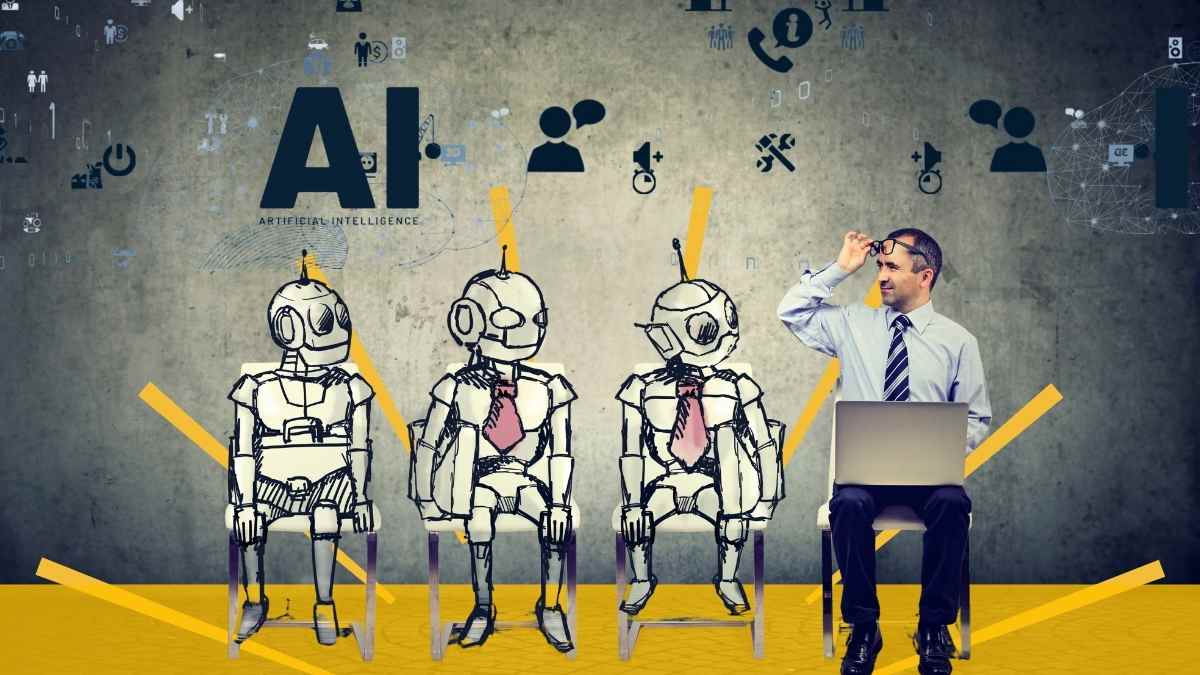
Last year, Nobel Prize laureate George Hinton received the award for his work on neural networks. He is called the Godfather of Artificial Intelligence for co-developing the backpropagation algorithm in the 1980s, which laid the foundation for today’s deep learning systems. He mentions in his speech at the ceremony, “the new form of AI excels in modelling human intuition rather than human reasoning. Unfortunately, this rather rapid progress comes with short-term risks. It has already created divisive echo chambers by offering people content that makes them indignant. Government authorities are using it for massive surveillance and by cyber criminals for fishing attacks.”
In the end, he has warned of existential threats that may arise once the digital beings created by AI become more intelligent than humans.
In a world increasingly run by algorithms, it’s easy to think AI is the obvious choice for content creation. After all, it’s fast, scalable, and getting eerily good at mimicking human tone. But if reasoning is abandoned in the area of business communication – where brands rely on understanding buyers’ needs and their decision-making to improve their business strategy – how will they predict growth and long-term sustainability?
The Human Edge in Brand Communication
Many brands overlook the basics of marketing, i.e., mind mapping to create a functional marketing mix and a conclusive, impactful go-to-market strategy. As brand owners or decision-makers, you’re not just looking for content that fills space. You need content that helps people understand how your brand can help them. The human touch in marketing cannot be entirely left to AI. Hence, it is necessary that a human pilots the brand strategy rather than AI running it.
Why a Humanistic Approach Outperforms AI
If we argue why the humanistic approach to content writing still outperforms artificial intelligence, the following key facts are an eye-opener:
Emotions Drive Sales. Period.
Your customers don’t just buy products — they buy stories, trust, and feelings. Marketing and content strategists use predictive analysis through mind mapping to generate insights for creating razor-sharp brand communication. If put in simple words, they understand emotions and what would drive the audience to buy your product. Emotions like fear, desire, and triumph can be reflected in your brand messaging, serving as a pull factor. AI can mimic tone, but it doesn’t feel. That’s a big gap.
Context Is King – Was, Is, and Always Will Be
Whether you’re launching a wellness brand or pitching SaaS solutions, your audience expects content that understands their world. Human writers bring in social, cultural, and industry-specific context. But, AI – it often misses the nuance — or worse, misreads it.
Original Thinking and Authenticity Matter
AI is not even a tool. It is an agent that mixes content that is already out there. There is zero innovation or creativity. In a crowded market, sounding like everyone else is a fast way to be forgotten. Content writers apply human intelligence, their skills, and experience to craft fresh ideas using insights, originality, and soul.
Your Brand Voice Deserves Consistency
Your brand’s personality needs to be more than just “on-brand.” It must feel authentic across every touchpoint. Writers adapt, evolve, and maintain that voice cautiously. AI-generated content fails to maintain the tone with emotional depth across long-term campaigns.
Trust Is Built Through Storytelling
Albert Einstein once said, “If you can’t explain it to a six-year-old, you don’t understand it yourself.”
If your content resonates with the audience, not just your targeted ones, you have won half the battle. Founder journeys, customer experiences, brand missions — these are powerful assets that connect your audience with your brand. An algorithm cannot generate such emotional depth.
Case example – Human vs AI in Content Writing
Product – Ergonomic Office Chair
AI-generated caption
“Upgrade your workspace with our ergonomic office chair. Designed for comfort and productivity. Shop now and get 20% off!”
Tone: Informational, too salesy, and straight to the point
Emotion: Absent
Connection: Low – sounds like any other product posts
Human-crafted caption
“Last night, I was getting a backache even in my dreams. I should get myself a chair that gives me better dreams and deep sleep.” Found one at 20% off — because sleep and comfort are more precious than anything.
Tone: Empathetic, conversational
Emotion: High – relatable to every working individual, even housewives. And taps into daily pain and lifestyle issues.
Connection: Strong – feels like a brand that understands you
Brand voice consistency cannot be taken lightly. It is the only means of building brand trust in a tangled web of the digital universe. The real need of your audience to buy your product lies in the content marketing strategy built on an in-depth understanding of their pain points. Why would they buy your product? If that sentiment is captured clearly, the buyer is on your side.
Final Thoughts
There is no denying that Artificial Intelligence, when used as a right fit and context, can be a blessing for modern-day, digitally driven marketing tactics. But if brands use it as a replacement for human intelligence, they risk losing the soul of their brand. The brand would fail to sustain for long. At the core of business strategy and brand storytelling — where human-to-human connection is crucial – AI can only be as good as a supporting tool for marketing. It cannot replace what human intelligence brings to the table.
In an automated world, brands that believe in using human specialization will appear authentic and stand out. Let’s not lose the soul of storytelling in the race for speed automation.